Hello.
I feel awkward typing this as it is my first real blog post. I have never done this before. I was thinking about the topic for my very first post and I decided that it should be Anglo-Saxon related. And why not given the name of my site and the art I chose to decorate it? As an aside, these posts will very much be stream of consciousness, I think editing a blog too heavily kind of ruins the charm.
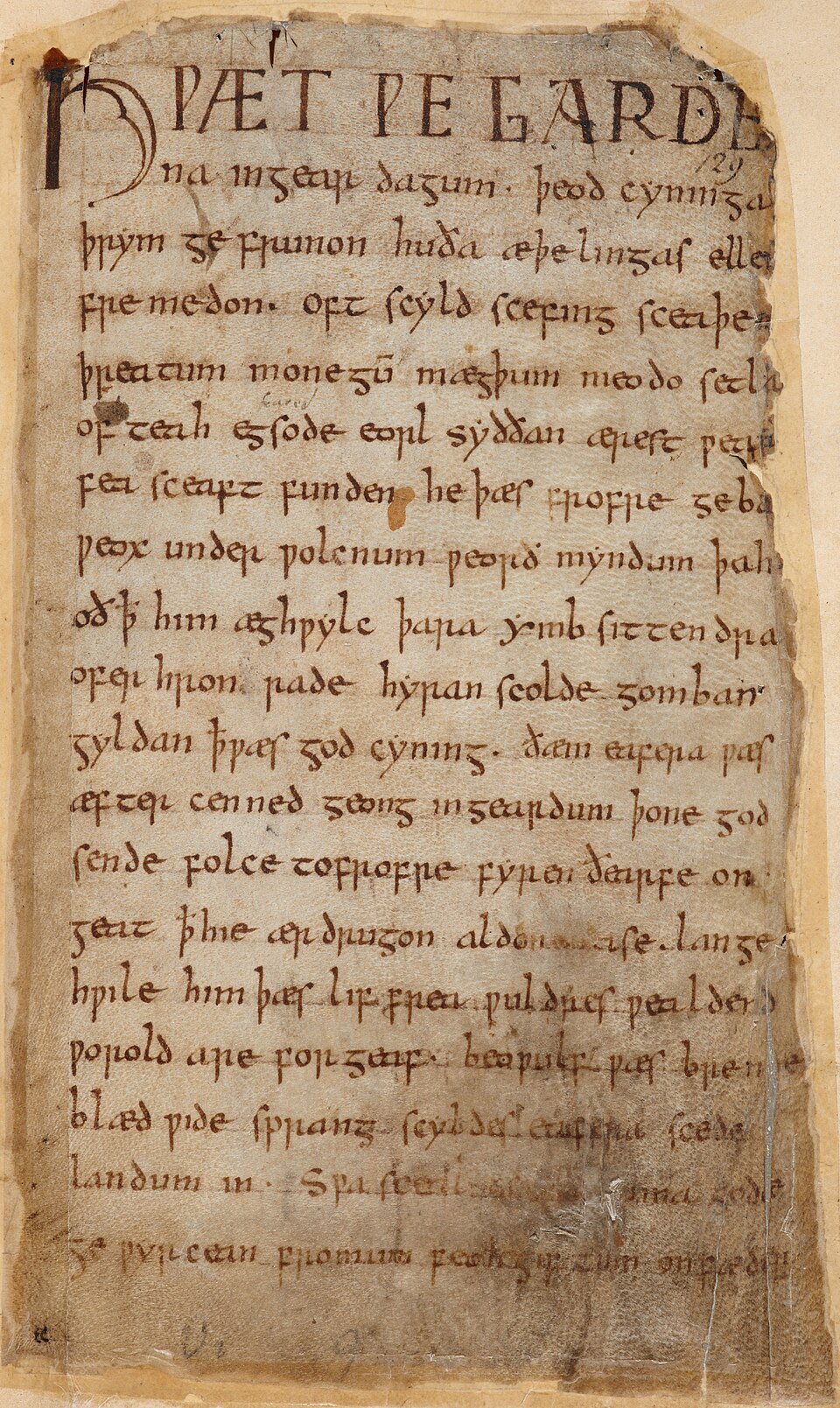
Beowulf is, in my opinion, one of the greatest poems ever put to paper, and one of the greatest stories ever told. Not only is it legendary in its form – over 3,000 alliterative lines written in Old English (or Anglo-Saxon) but it is probably the most important piece of literature from that time period, both as art, and as a historical monument to the time period. The poem gives us great insight in to the language, the culture, and the legends of the day.
One of the questions I often get asked when I have imaginary conversations with imaginary people who might listen long enough to indulge my love of Beowulf is – which translation should I read if I’ve never read Beowulf before? My answer always is – learn Old English! And while I wish this was a good answer, it’s not. Somebody remind me that one day I want to write a blog about how to start learning Old English. I hope my skills are good enough to read and enjoy the poem in its native language in full one day.
Seriously though, which translation should you read? Well there are a lot out there, but I will focus on three today, and you can decide for yourself which one appeals to you. The first is the translation by Seamus Heaney. The second, by J.R.R Tolkien, and the third by Frederick Rebsamen. I will mostly focus on the first two as the differences are striking, and I will round out the conversation with Rebsamen.
Seamus Heaney is an Irish poet, and without getting into his life story, is a Nobel Prize winner and legendary writer. In 1999, Heaney published Beowulf: A New Verse Translation and it has since become extremely popular both among casual readers and educators. The main appeal of his translation is how accessible it is to the modern reader. Heaney really focused on modern language while retaining the epic nature of the poem. Criticisms of this translation are that, its a bit too modern in that it is not a literal translation and does not always retain the flavour and feeling of the original work. Heaney’s work reads much like a song, and would be splendid to read aloud to somebody.
Tolkien needs no introduction, but his translation was published posthumously in 2014. The book opens with notes by Christopher Tolkien, as well as commentary which was the basis of Tolkien’s famous 1936 lecture “Beowulf: The Monsters and the Critics”. As a bonus, the book is packaged with two of Tolkien’s own works. The first is wonderful story called Sellic Spell which is an attempt by Tolkien to “reconstruct the Anglo-Saxon tale that lies behind the folk-tale element in Beowulf” – in his own words. The words Sellic and Spell both come from Old English and roughly translating to “strange tale” or “wondrous tale”. And the second bonus work we get in this text is two versions of Tolkien’s poem “The Lay of Beowulf”. Great stuff. Back to business – the translation itself is very academic in nature (as you can imagine). Tolkien favours archaism in his language to preserve the ancient feeling of the work. His prose is dense, but beautiful and very faithful to the original alliteration – he attempts to keep the four-beat alliterative line wherever possible. You can really feel Tolkien’s deep knowledge of the Anglo-Saxon language, culture, and form.
The famous and hotly debated opening word of the poem Hwæt – is translated by Tolkien as “Lo!” whereas Heaney translates the opening as “So.” I think this is a good example of the difference but here is a few more lines from the opening that are interesting.
Tolkien lines 1-3
Lo! the glory of the kings of the people of the Spear-Danes in days of old we have heard tell, how those princes did deeds of valour.
Heaney lines 1-3
So. The Spear-Danes in days gone by
and the kings who ruled them had courage and greatness.
We have heard of those princes’ heroic campaigns.
Tolkien’s language preserves the original’s grammatical structure while Heaney compresses the same idea into a more modern take. One more example?
Tolkien lines 710-714
He came now from the moor under misty fells
Grendel walking. The wrath of God was on him.
Foul thief, he purposed of the race of men
someone to snare within that lofty hall.
Heaney lines 710-714
In off the moors, down through the mist bands
God-cursed Grendel came greedily loping.
The bane of the race of men roamed forth,
hunting for a prey in the high hall.
So what does this all mean for you? Well, if you have an academic interest in the work or you are interested in a more literal, faithful, and epic feeling translation, go with Tolkien. If you are a casual reader looking for something more modern and accessible but it still fairly faithful and is still a fantastic work of poetry, go with Heaney.
As a final note – Rebsamen’s translation is a very strong alternative. Rebsamen preserves the alliterative meter excellently at the cost of some elision and also some inventions. He invented several knew kennings for the work (a kenning is an Anglo-Saxon figurative compound term used in place of a single noun. For example “whale’s road” means “sea”). This work is also a great option but maybe is better for a second or third read through in my opinion.
This ended up being a bit longer than intended. I wanted to ramble about my thoughts on the authorship and composition date of Beowulf, but perhaps its best left to another post. The short form is that scholars believe it was written sometime between the 8th and 11th centuries (c. 700-1000 AD). My personal opinion after many wasted hours of research is that it was composed in the 8th century, likely the mid to late 8th century.
That’s all for now. Thank you.
– Pybba
 Pybba Speaks
Leave a comment